Top Portfolio Reporting Tools for Family Offices: The 2026 Evaluation Guide
65% of family offices still rely on spreadsheets. Compare the top portfolio reporting tools for 2026 on AI automation, total wealth consolidation, and succession-ready dashboards.
Apr 14, 2026
Family offices,
AI



Key Takeaways
Nearly two-thirds of family offices still depend on manual methods for wealth aggregation and reporting, according to the 2025 North America Family Office Report from Campden Wealth and RBC.
Evaluating the top portfolio reporting tools comes down to three capabilities: whether the platform consolidates all assets and custodians automatically, whether it processes private markets documents without manual intervention, and whether its data layer is open enough to build on.
The 2026 market divides into four distinct categories: AI-native platforms, institutional analytics engines, operational accounting platforms, and portfolio trackers, each solving a different primary problem.
The right platform is determined by asset complexity and stakeholder mix, not feature count. Over-buying on platform depth is as costly as under-buying.
AI-native platforms can process private markets documents that previously required 15–20 staff hours per month in minutes.
What Is a Portfolio Reporting Tool?
A portfolio reporting tool is software that pulls investment data from multiple sources, reconciles it, and presents a structured, auditable picture of total wealth. In a family office context, that means bringing public equities, private funds, real estate, direct investments, and alternative assets (held across multiple custodians, legal entities, and currencies) into a single report that any stakeholder can open and immediately trust.
The difference between a generic tracker and a platform built specifically for family offices is not cosmetic. Generic tools are engineered for single-entity, single-currency retail or advisory portfolios. Family office reporting platforms are built around multi-entity ownership hierarchies, illiquid asset classes, and the reality that the people reading the reports range from investment analysts to Principals to next-generation heirs with no financial background.
In 2026, the category has expanded to include AI-powered capabilities: automated document ingestion, natural language queries against live portfolio data, predictive liquidity modeling, and open data layers that allow custom AI agents to operate on top of the wealth data foundation.
Aleta Edge Family Office Newsletter
Subscribe here to get the next edition of Aleta Edge – a curated monthly newsletter for forward-thinking family offices.
Why Legacy Reporting Creates Operational Risk for Family Offices
According to the 2025 North America Family Office Report from Campden Wealth and RBC, roughly two-thirds of family offices still depend on manual methods for reporting and wealth aggregation. That figure points to something more than an operational inconvenience. Each new fund commitment, additional custodian relationship, or entity added on top of a manual foundation increases the risk exposure of a system that was never designed to carry that weight.
The risk shows up in three distinct and compounding ways.
Data Integrity Risk
Every manual data entry in the reporting chain is a potential failure point. In a consolidated net worth statement, a miskeyed figure can misstate a position by millions, and in a manual workflow there is no systematic mechanism to catch it before it reaches a decision-maker. Private markets documents (capital call notices, NAV statements, K-1s) require staff to extract and re-enter data that purpose-built platforms ingest automatically.
Institutional Knowledge Risk
Spreadsheet-based reporting concentrates critical knowledge in whoever built and maintains the file. Embedded formulas, manual adjustments, and undocumented logic accumulate over time, and none of it survives a personnel change intact. The next hire inherits a model they did not build, structured around assumptions they were not there to learn. The reporting infrastructure cannot outlast the person who created it.
Succession Risk
Reporting technology plays a less visible but important role in succession. Senior family members typically hold a comprehensive mental map of the portfolio: which positions exist, which commitments are pending, which relationships matter. That map rarely transfers in full to the next generation. Heirs receiving a collection of spreadsheets and static statements get a partial picture. Those inheriting access to a live, consolidated platform get context.
What Should the Top Portfolio Reporting Tools Include? A 2026 Buyer’s Checklist
Feature lists across vendors can look almost identical at the marketing level. The six criteria below are designed to separate platforms that genuinely address the family office data problem from accounting tools and portfolio trackers that have been repositioned as wealth reporting solutions.
1. Total Wealth Consolidation Across All Asset Classes
The platform must automatically pull and reconcile data from every source (banks, custodians, private equity managers, real estate funds, and alternative investment vehicles) into one verified net worth picture. A platform that excels at public markets but requires manual input for private equity or real estate is a partial solution, not a total wealth consolidation tool.
2. AI-Powered Private Markets Document Processing
Processing private markets documents (K-1s, capital call notices, distribution notices, NAV statements) is the most labor-intensive reporting task in a typical family office. A platform with genuine AI automation ingests these documents and reconciles the extracted data without any manual step. The performance benchmark is clear: platforms like Aleta’s Aleta Intelligence suite process in minutes what previously took 15–20 staff hours per month. During any evaluation, the clearest test is to hand a vendor one of your own K-1s or capital call notices and ask them to process it live. Not a curated demo file.
3. Open API and Agent-Ready Architecture
Open APIs allow wealth data to move freely into tax systems, general ledgers, BI tools, and custom AI infrastructure. The frontier of portfolio reporting in 2026 is agentic: software that monitors positions continuously, surfaces anomalies without being prompted, drafts IC reports from live data, and answers natural language queries about specific exposures. The prerequisite is a clean, open data layer that is structured, reconciled, and accessible via API. Platforms that lock data inside proprietary environments make this kind of infrastructure impossible to build, regardless of what AI features they advertise at the surface level.
4. Multi-Entity, Multi-Currency Reporting
Family office portfolios span multiple legal entities (such as trusts, LLCs, holding companies, foundations) across currencies and jurisdictions. The platform must handle this complexity and produce a consolidated view that accurately reflects the family’s actual ownership structure, not a simplified proxy.
5. Multi-Stakeholder Access and Dashboards
The Principal, the CFO, the investment team, and next-generation family members all need different views of the same underlying data. Purpose-built platforms provide role-based access with interfaces calibrated for each audience, so that a Principal checking in from a mobile device and an analyst running attribution analysis are both served without manual report exports or version management.
6. Implementation Speed and Data Portability
Request a specific implementation timeline from every vendor, including when custodian integrations will be live. Ask explicitly about data export rights. Cloud-native family office platforms typically go live in 4–8 weeks. Institutional and accounting-heavy platforms generally need 6-9 months. Enterprise configurations with significant customization can extend to 6–12 months. A longer timeline is not evidence of a more capable platform.
The Portfolio Reporting Tool Landscape in 2026
The market in 2026 divides into four broad categories. Understanding which category a platform falls into matters more than comparing individual features, because platforms in different categories are built to solve fundamentally different problems.
Aleta is an AI-native wealth intelligence platform built specifically for single and multi-family offices. It is the only platform reviewed here that combines a Principal-first interface, institutional-depth reporting, and native AI document automation in a single open-architecture environment. The platform monitors over $100 billion in assets, holds 100+ custodian integrations, and was named Best Data Provider at the Family Wealth Report Awards 2026 and awarded Best Consolidated Reporting at the WealthBriefing Awards 2026. Flat-rate pricing begins at approximately $1,000 per month.
Addepar is an institutional analytics platform built for large family offices and registered investment advisors managing significant public market portfolios. Its performance attribution depth and statistical risk modeling make it the preferred tool for investment analysts who need quantitative precision. It is less suited to offices whose primary need is private markets consolidation or Principal-facing accessibility.
Masttro is a traditional wealth management and reporting platform serving single and multi-family offices, wealth managers, and private banks. Its subscription pricing is independent of assets under management, which is a meaningful structural advantage for very large offices. Native AI automation for private markets documents is not part of the current offering.
FundCount integrates accounting and portfolio oversight into a single platform. It serves offices managing complex partnership structures and direct investments where investment-grade accounting precision and portfolio reporting need to coexist in one environment.
Archway is an operational accounting platform with a long track record in the family office segment. It is designed for offices where back-office infrastructure (general ledger, entity accounting, operational workflows) is as central a requirement as the reporting layer itself.
Asora is a lightweight portfolio tracking platform focused on accessible data visualization. It is a practical step up from spreadsheets for smaller or earlier-stage offices that need clean portfolio visibility without the overhead of a full institutional reporting platform.
Swimbird is a portfolio management platform that provides a unified view of assets and liabilities across investment portfolios. It is used by family offices, banks, and asset managers that need structured data visualization and exposure monitoring across multiple sources.
For a detailed platform-by-platform comparison including capabilities, implementation timelines, pricing, and fit-for-purpose analysis, see our full guide here: Best Wealth Reporting Software for Family Offices in 2026: The Complete Market Guide
At a Glance: How the Top Portfolio Reporting Tools Compare
Platform | Primary Strength | Typical User | AI Automation |
|---|---|---|---|
Aleta | AI-native total wealth consolidation. | SFO / MFO — all stakeholders | Full (native) |
Addepar | Deep public market analytics. | Large offices, investment analysts. | Partial |
Masttro | Traditional wealth reporting. | Offices avoiding AUM pricing. | Limited |
FundCount | Integrated accounting + reporting. | Offices needing GL + portfolio in one. | Partial |
Archway (SEI) | Operational accounting depth. | Offices with back-office complexity. | Limited |
Asora | Lightweight data visualization. | Smaller / early-stage offices. | No |
Swimbird | Asset & liability portfolio views. | Multi-institutional users. | No |
How to Choose the Right Portfolio Reporting Tool for Your Family Office
The right platform is the one that most directly addresses your specific reporting problems, fits your ownership structure, and gets used consistently by everyone it is meant to serve.
Start With Your Primary Pain Point
The most productive starting point for any evaluation is a single question: what is the reporting problem that costs us the most time or creates the most risk right now? If the answer is manual private markets processing, the search narrows to AI-native platforms. If it is the absence of a verified consolidated balance sheet, it narrows to consolidation-first platforms. If accounting and investment data live in separate systems that produce conflicting outputs, it narrows to integrated platforms. Starting with the problem rather than the feature list produces a much cleaner shortlist.
Match Complexity to Platform Depth
An office managing a few hundred million across a handful of custodians has different requirements from one overseeing several billion across dozens of entities and jurisdictions. Selecting a platform calibrated for institutional-scale complexity when it is not needed adds implementation time, operational overhead, and adoption friction without adding proportionate value. The inverse – selecting a lightweight tool for a structurally complex portfolio – creates new gaps rather than closing existing ones.
Evaluate for the Next Generation, Not Just the Current Team
Succession is increasingly one of the primary drivers of platform adoption. The generation inheriting wealth today grew up expecting financial information to be as immediate and accessible as any other data on their phone. A platform that requires training to navigate, or that delivers information as a PDF attachment, creates a structural barrier to engagement. The right platform removes that barrier entirely: a mobile interface built for non-financial users means the next generation can engage with their own wealth data on their own terms, rather than depending on a quarterly summary from the investment team.
In a recent client meeting, it was the first time both generations sat down together and saw their own data in one place. Some of it for the very first time. The comments that followed were immediate: ‘I didn’t even know we had these investments.’ ‘I completely forgot about that fund. We made that commitment over 10 years ago, and it’s worth double what I thought.’ That moment when a complete, verified overview of the family’s entire wealth appears on screen for the first time is a powerful reminder of the real role a platform like Aleta can play during generational transition.
Ask These Six Questions of Every Vendor
Can you process one of our actual K-1s or capital call notices live, right now, during this call?
For each of our custodians and alternative managers, is the connection a direct API, a third-party aggregator, or a manual upload?
What is the specific date by which consolidated reporting will be live for us?
If we decide to leave, can we export our complete dataset immediately and in full?
What does the access experience look like for a Principal or a next-generation family member with no investment background?
If our AUM doubles in three years, how does your pricing change?
A vendor that answers all six with specifics and evidence is worth proceeding with. One that deflects, pivots to reference calls, or defaults to generalities is telling you something important about how the implementation will go.
Conclusion: Staying Manual Is Not a Neutral Choice
Maintaining a manual reporting environment is not a neutral holding position. With each new fund commitment, each additional custodian relationship, and each year without a structured data layer, the risk profile of the office grows quietly. Discrepancies accumulate undetected, financial data moves through unsecured channels, and the gap between what the founding generation understands and what the next generation can access gets harder to close.
Campden Wealth and RBC data shows automated reporting adoption climbing from 46% to 69% in a single year. A rate of change that indicates the industry has moved past the early-adopter phase. For offices still evaluating, the question is no longer whether a modern reporting platform is necessary. It is which one is the right fit.
What the strongest implementations have in common is a clear first objective: get to one authoritative, verified view of the total portfolio – accessible to the Principal, the investment team, the CFO, and the next generation without version management or manual translation. Every capability built afterward depends on that foundation being solid.
FAQ: Top Portfolio Reporting Tools
What are the top portfolio reporting tools for family offices in 2026?
What are the top portfolio reporting tools for family offices in 2026?
The leading portfolio reporting tool for family offices in 2026 is Aleta. It combines consolidated reporting, Aleta Intelligence for AI-powered document automation, a built-in investment GL, and open API architecture with an award-winning Principal interface backed by SOC 2 Type II certified data security. Addepar is the strongest alternative for large institutional offices focused on quantitative investment analytics. Aleta goes live in 4 to 8 weeks from $1,000 per month.
What is the difference between a portfolio reporting tool and a portfolio tracker?
What is the difference between a portfolio reporting tool and a portfolio tracker?
A portfolio tracker aggregates and displays investment data (typically publicly traded assets) in a visual dashboard. A portfolio reporting tool covers significantly more ground: it reconciles data across multiple sources, handles illiquid asset classes, produces multi-entity consolidated reports, and in the most advanced platforms automates the processing of unstructured private markets documents. Family offices managing complex ownership structures and private markets allocations need a reporting platform, not a tracker.
How does AI improve portfolio reporting for family offices?
How does AI improve portfolio reporting for family offices?
One impactful application of AI in portfolio reporting is document processing. Private markets generate high volumes of unstructured documents (capital call notices, K-1s, NAV statements, distribution notices) that have historically required staff to process manually. AI-native platforms like Aleta extract and reconcile this data automatically, eliminating what is typically 15–20 staff hours of manual work per month and replacing it with a clean, structured data record. Beyond document processing, leading platforms apply AI to anomaly detection, natural language portfolio queries, and maintaining the open data layer needed for AI agent deployment.
What does total wealth consolidation mean in portfolio reporting?
What does total wealth consolidation mean in portfolio reporting?
Total wealth consolidation is the aggregation of investment data from every custodian, bank, fund manager, and alternative investment vehicle into a single reconciled view of net worth, across all entities, currencies, and asset classes. The ‘total’ qualifier matters: a platform that covers public markets but leaves private equity or real estate as manual inputs does not provide total consolidation. It provides a partial view, which is precisely the problem most family offices are trying to solve.
What is the typical deployment timeline for a portfolio reporting platform?
What is the typical deployment timeline for a portfolio reporting platform?
Implementation timelines vary by platform category. Dedicated family office platforms built on cloud-native architecture, such as Aleta, typically go live within four to eight weeks, with custodian connections active in the first week. Platforms with heavier operational accounting requirements generally need several months. Enterprise configurations with significant customization can take six to twelve months or more. Longer timelines reflect implementation complexity, not platform quality.
Is an open API important when choosing a portfolio reporting tool?
Is an open API important when choosing a portfolio reporting tool?
Yes, and increasingly so. An open API means the platform’s data can flow into other systems: tax software, general ledgers, custom dashboards, and AI infrastructure. Closed platforms create the opposite dynamic: each new tool the office wants to add becomes an integration project or simply impossible. In practical terms, the family offices building the most sophisticated reporting environments in 2026 (with AI agents monitoring portfolios and generating reports automatically) are all doing it on top of open-architecture platforms. A closed system today forecloses those options entirely.
What is the best portfolio reporting tool for multi-generational family offices?
What is the best portfolio reporting tool for multi-generational family offices?
For multi-generational family offices, the most important evaluation criterion is often the one that gets addressed last: can the next generation actually use this platform? Tools built for institutional investment analysts carry a learning curve that is a structural barrier for digital-native heirs who expect any financial interface to be as intuitive as the apps they already use. The most effective platforms for multi-generational offices provide institutional reporting depth for the investment team and a mobile-first, no-training-required interface for the Principal and next-generation family members. Aleta is one of these platforms.
Are top portfolio reporting tools only for large family offices?
Are top portfolio reporting tools only for large family offices?
Portfolio reporting at institutional quality is no longer restricted to the largest offices. Platforms with flat-rate, non-AUM-based pricing have removed the cost barrier that previously made this technology inaccessible to smaller or emerging family offices. Aleta, for example, starts at approximately $1,000 per month with pricing independent of assets under management. The operational case for consolidated reporting, automated private markets processing, and multi-stakeholder dashboards is just as strong for an office managing $75 million as for one managing $750 million.
What questions should I ask when evaluating portfolio reporting vendors?
What questions should I ask when evaluating portfolio reporting vendors?
The six questions that most reliably separate capable platforms from overpromised ones: (1) Can you process one of our real private markets documents live during this evaluation? (2) How exactly is each of our custodians connected: direct API or something else? (3) What is the specific go-live date for consolidated reporting? (4) Can we export our complete data on request? (5) What is the access experience for non-financial stakeholders on mobile? (6) How does your pricing scale if our AUM doubles? Vague or deferred answers to any of these are informative.
Additional Reads Selected for You

AI Vendor Security Due Diligence Questions for Family Offices in 2026
AI vendor security due diligence questions family offices should ask in 2026 before connecting AI to wealth data, what good answers look like, and red flags.
Sep 29, 2026
AI,
Family offices

Is It Safe to Connect an AI Assistant to Family Office Data in 2026?
Aleta on what to check on training, retention, permissions, and logs before you connect.
Sep 28, 2026
AI,
Family offices
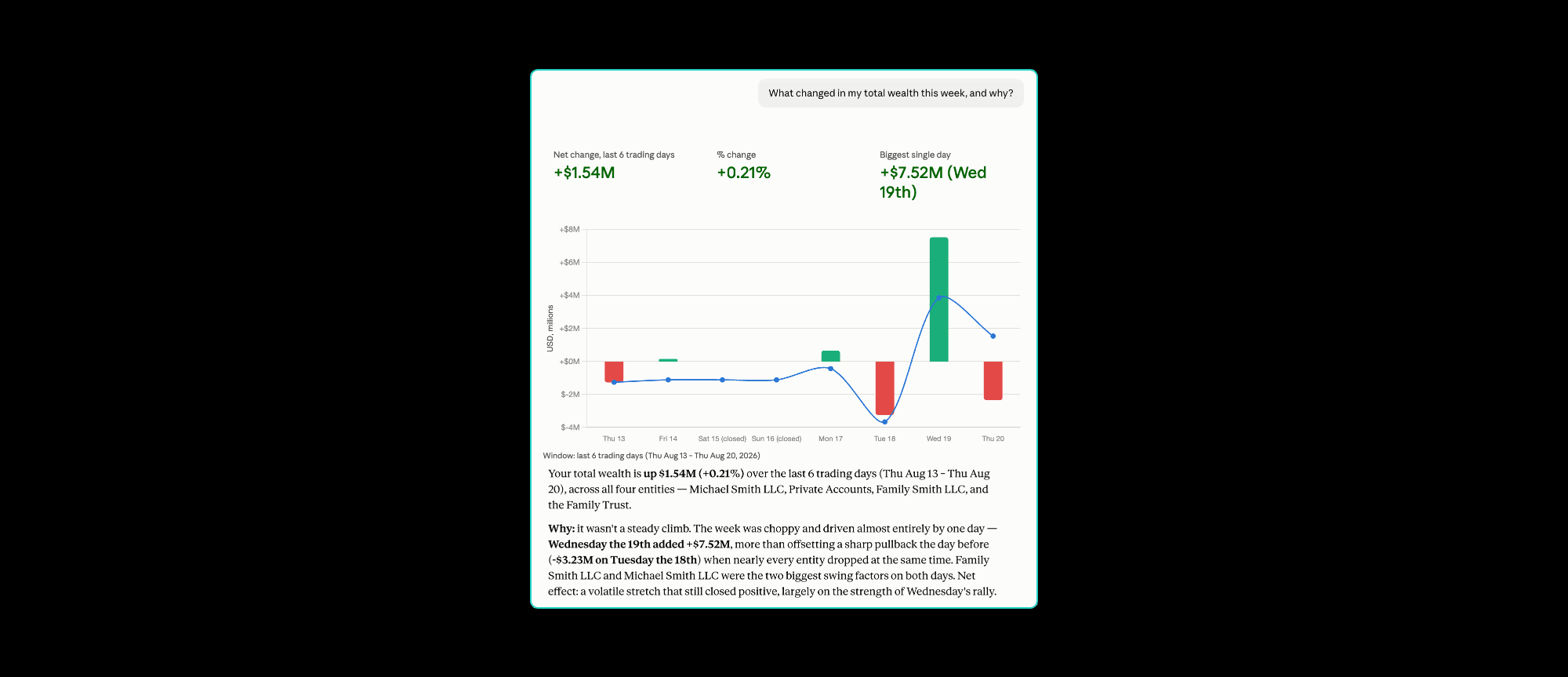
Real Prompts You Can Steal: How Family Offices Use AI Agents on Their Wealth Data
11 real prompts family offices run with AI agents on wealth data, from performance and liquidity to compliance and automation, with answers and screenshots.
Aug 25, 2026
AI,
Family offices