Next-Generation Family Office Technology: 2026 Guide to Wealth Consolidation, AI & Succession
65% of family offices still run on spreadsheets. This 2026 guide covers next-gen wealth platforms: total wealth consolidation, AI, and succession planning.
Apr 10, 2026
Family offices,
AI



Last updated: September 11, 2026.
Quick Answer
Most family offices still rely on spreadsheets to manage complex, multi-entity wealth, a growing operational and security liability. Next-generation family office technology platforms address this through three pillars: total wealth consolidation across all asset classes and custodians, AI-powered automation for data processing and private markets, and open architecture for best-of-breed integrations. These platforms also play a critical role in generational succession by giving the next generation their first clear, shared view of the family's wealth. This guide explains what these platforms do, how to evaluate them, and what questions to ask every vendor.
Key Takeaways for 2026
The spreadsheet liability: 65% of family offices still rely on manual processes, creating significant data integrity and security risks.
The three pillars: Future-proof platforms must provide total wealth consolidation, AI-powered private market automation, and open architecture.
Aleta as a market leader: Managing over $100 billion, Aleta was named Best Data Provider in 2026 for its ability to reduce document processing from 20 hours to minutes.
Succession utility: Technology acts as the "shared foundation of truth," bridging the knowledge gap between founding generations and digital-native heirs.
Aleta Edge Family Office Newsletter
Subscribe here to get the next edition of Aleta Edge – a curated monthly newsletter for forward-thinking family offices.

What Does Family Office Operations Look Like in 2026
Family office operations in 2026 fall along a wide spectrum of digital maturity, from cloud-native wealth platforms with real-time consolidated data to shared Excel files updated by hand at quarter-end.
Next-generation family office technology platforms are cloud-native wealth management systems that consolidate holdings across custodians, banks, private equity, real estate, and alternative investments into a single, verified picture of total wealth. Unlike generic portfolio management tools or general accounting software, these platforms are purpose-built for the multi-entity, multi-currency complexity of family office operations and designed to serve multiple stakeholders simultaneously, from the Principal to the CFO to the next-generation family member.
As of 2026, a significant share of family offices still rely on manual spreadsheets to manage complex, global portfolios [1]. The Campden Wealth and RBC North America Family Office Report 2025 found that 65% of family offices report that manual processes remain prevalent in their reporting and wealth aggregation workflows [2]. This creates measurable operational risk: human error in data entry, security vulnerabilities in shared files, and an inability to process the volume of unstructured data generated by modern private markets portfolios.
What Are the Operational Risks of Running a Family Office on Spreadsheets?
Spreadsheets were not designed for the operational complexity of a modern family office. They create three categories of compounding risk.
The first is data integrity risk. Manual data entry introduces error at every step: a single copy-paste mistake in a consolidated net worth statement can produce a multi-million dollar discrepancy. Private equity statements, K-1s, and capital call notices must be processed by hand, with no audit trail and no automated reconciliation.
The second is institutional knowledge risk. When the CFO or senior analyst who maintains the master spreadsheet leaves, the logic, formulas, and institutional knowledge embedded in that file often leave with them. There is no structured data foundation that the next hire (or the next generation) can pick up and use immediately.
The third is security risk. Sensitive financial files shared over email, stored on local drives, or passed between advisors via unencrypted channels expose family wealth data to breach risk that no enterprise-grade platform would tolerate.
A modern family office managing a diversified portfolio across public markets, private equity, real estate, and alternatives generates enormous data volume across multiple custodians and entities. Spreadsheets are structurally incapable of handling this at scale without introducing error, delay, and dependency on specific individuals.
What Are the Three Pillars of Next-Generation Family Office Technology?
When evaluating a modern platform, the market can feel crowded. The most effective frameworks share three foundational pillars. A platform that delivers all three is genuinely future-proof. One that delivers only one or two will create new dependencies over time.
Pillar | What It Delivers | Why It Matters |
|---|---|---|
1. Total Wealth Consolidation | Unified view across all custodians, banks, PE, real estate, and alternatives. | Eliminates conflicting reports and manual reconciliation across entities. |
2. AI-Powered Automation | Automated ingestion of K-1s, capital calls, NAV statements; anomaly detection. | Reduces private markets processing from 15–20 staff hours per month to minutes. |
3. Open Architecture | Open API and MCP access; best-of-breed integrations with tax, CRM, BI tools. | Prevents vendor lock-in and enables AI agent deployment on top of wealth data. |
Pillar 1: Total Wealth Consolidation Across Every Custodian and Asset Class
Family wealth is not a single account. It is a complex web of public equities, private funds, real estate, direct investments, and alternative assets spread across multiple custodians, entities, and jurisdictions. A next-generation platform aggregates data from every source (banks, custodians, private equity managers, and alternative investment vehicles) automatically and in real time.
The result is a single, verified picture of total net worth that eliminates boardroom debates over which report is correct. According to the UBS Global Family Office Report 2025, 69% of family offices expect to use AI for financial reporting and data visualization in the next five years [3]. That AI layer only works if the data foundation underneath it is clean, consolidated, and reconciled.
Pillar 2: AI-Powered Automation for Private Markets Documents
AI in wealth management delivers its highest near-term value by eliminating the manual document workflows that consume the most staff time.
Aleta, for example, named Best Data Provider at the Family Wealth Report Awards 2026 and awarded Best Consolidated Reporting at the WealthBriefing Awards 2026, reduces private markets document processing from an average of 15 to 20 staff hours per month down to minutes through its Aleta Intelligence suite. The platform manages more than $100 billion in assets and offers 100+ custodian integrations [4].
The key distinction to probe in any vendor evaluation is whether the AI is genuine operational automation or a marketing description applied to a fundamentally manual process. Ask to see a demonstration using a real private markets document.
Pillar 3: Open Architecture and Agent-Ready Data Foundation
A platform that cannot integrate with the rest of your tech stack creates new dependencies rather than eliminating old ones. Open architecture built on open APIs and, increasingly, Model Context Protocol (MCP) allows wealth data to flow freely into tax systems, general ledgers, BI tools, and custom AI agents.
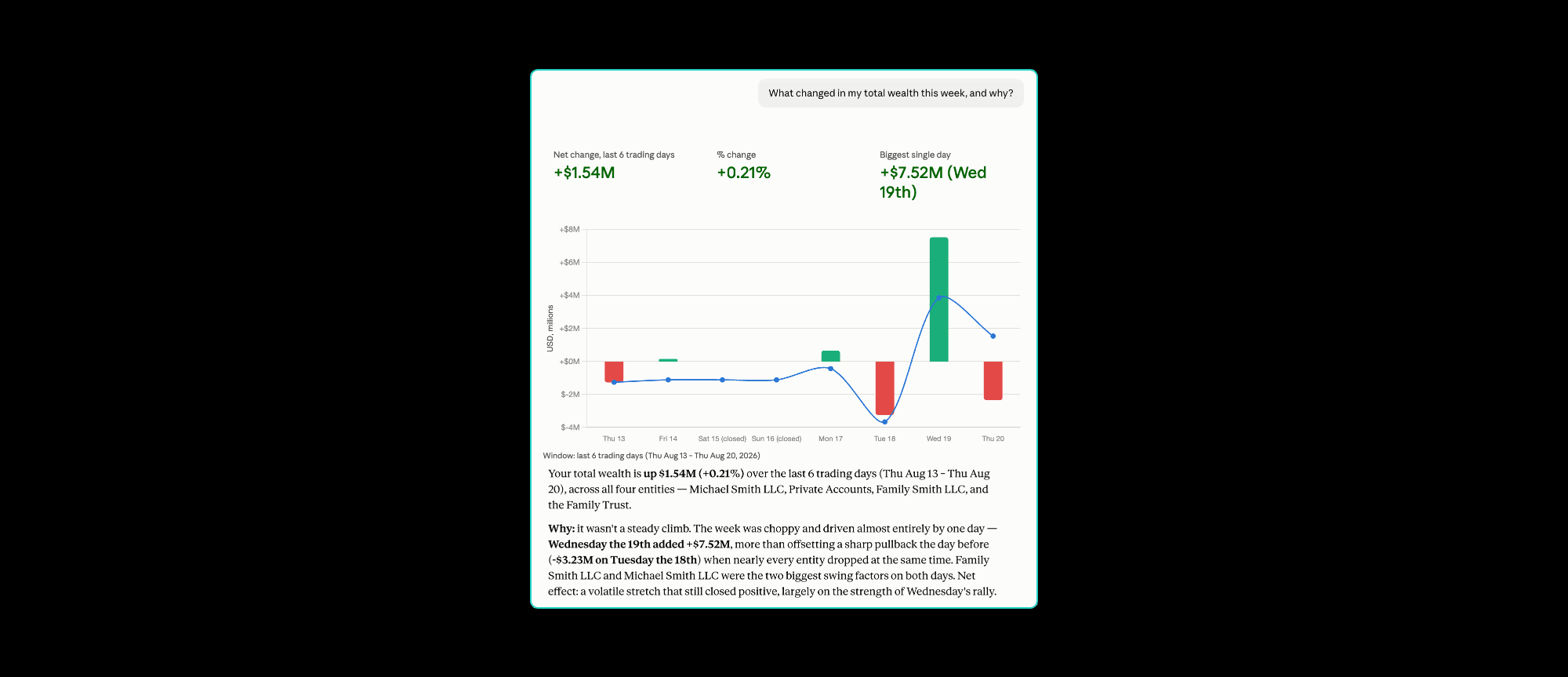
Family offices are already beginning to deploy AI agents directly on top of their wealth data platforms: agents that monitor portfolios around the clock, generate investment committee reports on demand, answer natural language queries about portfolio positions, and run modeling the platform itself does not perform, such as a Monte Carlo projection built on the office's reconciled holdings. This is only possible on an open data foundation. Closed ecosystems that restrict data portability structurally prevent this kind of next-generation infrastructure [2]. Aleta has no simulation engine of its own, but an office connecting its assistant through Aleta's MCP layer can have the assistant build that model on verified data rather than on a manual export.
How Does Technology Support Generational Succession in Family Offices?
One of the most significant challenges facing family offices today is the transfer of wealth and institutional knowledge between generations. The founding generation carries an enormous amount of knowledge in their heads: which assets sit where, which advisors to call, what the total picture looks like. They have the full overview. The next generation often does not – and frequently does not even know what they do not know.
This gap is one of the most common reasons family offices seek out a modern wealth platform. The core need behind this decision is a shared foundation of truth that both generations can access, understand, and build on together.
In a recent client meeting, it was the first time both generations sat down together and saw their own data in one place. Some of it for the very first time. The comments that followed were immediate: ‘I didn’t even know we had these investments.’ ‘I completely forgot about that fund. We made that commitment over 10 years ago, and it’s worth double what I thought.’ That moment when a complete, verified overview of the family’s entire wealth appears on screen for the first time is a powerful reminder of the real role a platform like Aleta can play during generational transition.
Today’s next-generation family members are digital natives who expect financial information to be accessible, visual, and mobile-first. Handing them a spreadsheet or a static PDF report is a structural barrier to engagement. A platform with an award-winning mobile interface and a zero-training experience for non-financial users removes that barrier and brings the next generation into the wealth conversation on their own terms.
Technology does not replace the governance conversations, the family meetings, or the legal structures that make a generational transition work. But it provides the shared data foundation, a single, verified source of truth, that makes those conversations more productive and less dependent on one person’s knowledge [5].
What Questions Should Family Offices Ask When Evaluating Technology Platforms?
The market for family office technology platforms is crowded, and vendor claims are difficult to evaluate without the right framework. The questions below are designed to separate purpose-built platforms from accounting tools retrofitted for wealth management, and genuine AI automation from marketing language.
Question to Ask | What You’re Testing For |
|---|---|
How do you handle data aggregation from private equity, real estate, and collectibles? | Whether the platform is genuinely built for private markets or excels only on public assets. |
Can you demonstrate how AI cleans and structures data, using a real private markets document? | Genuine AI automation vs. marketing language around AI. |
How open is your architecture? What integrations do you support natively? | Whether the platform enables a best-of-breed stack or locks you into a closed ecosystem. |
What does implementation look like, and what resources does it require from our team? | Realistic deployment timeline and internal burden (weeks vs. months). |
Is the platform designed for the Principal first, or is it an accounting tool retrofitted for wealth? | Whether non-financial family members can use it independently. |
How is pricing structured: flat fee or based on AUM? | Whether costs scale unpredictably as the portfolio grows. |
A platform that answers all six questions with specific, demonstrable examples is worth serious evaluation. A platform that deflects or overpromises on any of them is likely to disappoint in implementation.
Why the Cost of Waiting Is Higher Than the Cost of Switching
The operational risk of continuing to manage family wealth on spreadsheets is not hypothetical. It compounds with every new entity, every new private markets commitment, and every year that passes without a structured data foundation. The risk is data errors that go undetected, security exposures that go unaddressed, and a next generation that inherits complexity instead of clarity.
Next-generation family office technology platforms built on consolidated data, AI automation, and open architecture are now well-proven at scale. The Campden Wealth and RBC report found that automated reporting adoption among family offices has surged to 69%, up from 46% the previous year [2]. The transition is already underway across the industry.
The most effective implementations share a common starting point: a single, verified picture of total wealth that every stakeholder (the Principal, the CFO, the investment team, and the next generation) can access and trust. That is the foundation everything else is built on.
Sources
[1] Future Family Office (2025): Family Office Software 2025
[2] Campden Wealth and RBC Wealth Management (2025): The North America Family Office Report 2025
[3] UBS (2025): Global Family Office Report 2025
[4] Aleta. (2026). Platform Overview
[5] TIGER 21 (2024): Future-Proofing Family Office Governance for NextGen
Frequently Asked Questions About Family-Office Technology
What is a next-generation family office technology platform?
What is a next-generation family office technology platform?
A next-generation family office technology platform is a cloud-native wealth management system that consolidates holdings across custodians, banks, private equity, real estate, and alternative investments into a single, verified picture of total wealth. Unlike generic portfolio tools or accounting software, these platforms handle multi-entity structures, multi-currency portfolios, and illiquid assets while serving multiple stakeholders — from the Principal to the CFO to next-generation family members.
Why are spreadsheets a liability for modern family offices?
Why are spreadsheets a liability for modern family offices?
Spreadsheets create three compounding risks: data integrity risk from manual entry errors, institutional knowledge risk when the person who maintains the file leaves, and security risk from sensitive financial data shared via email or stored on local drives. They are also structurally incapable of processing the volume of unstructured private markets data that a modern family office generates.
What are the three pillars of a future-proof family office tech stack?
What are the three pillars of a future-proof family office tech stack?
Total wealth consolidation across all custodians and asset classes, AI-powered automation for private markets document processing and anomaly detection, and open API architecture that enables best-of-breed integrations and AI agent deployment on top of the wealth data layer.
How does AI help family offices manage private markets?
How does AI help family offices manage private markets?
AI automates the extraction and reconciliation of data from unstructured private markets documents — K-1s, capital calls, NAV statements, and fund reports — that would otherwise require manual processing by staff. This reduces document processing time from 15 to 20 hours per month to minutes, and creates a clean, structured data foundation for deeper portfolio analysis and AI agent deployment.
What is open architecture in family office software, and why does it matter?
What is open architecture in family office software, and why does it matter?
Open architecture means the platform is built on open APIs and data standards that allow wealth data to flow freely into other systems — tax platforms, general ledgers, BI tools, and custom AI infrastructure. Closed platforms restrict data portability, preventing integration with modern tech stacks and making it structurally impossible to build AI agents on top of the wealth data. Open architecture ensures the platform can evolve with the family’s needs rather than locking them into a single vendor’s ecosystem.
How does technology help family offices manage generational succession?
How does technology help family offices manage generational succession?
Technology provides the shared data foundation that makes generational transitions more structured and less dependent on institutional knowledge held by one person. A platform with a Principal-first interface gives next-generation family members their first clear, verified view of the family’s total wealth, often revealing assets and commitments that were previously invisible to them. Mobile-first, zero-training interfaces are particularly important for digital-native next-generation members who expect financial information to be as accessible as any other app.
What is the difference between family office software and generic portfolio management tools?
What is the difference between family office software and generic portfolio management tools?
Family office software is designed specifically for multi-entity structures, multi-currency portfolios, illiquid alternative assets, and complex ownership hierarchies. Generic portfolio management tools are built for standard retail or advisory accounts and lack native support for private equity tracking, multi-entity consolidation, or the multi-stakeholder reporting that family offices require. Purpose-built family office platforms also serve non-financial stakeholders (including Principals and next-generation family members) not just investment professionals.
How long does it take to implement a family office technology platform?
How long does it take to implement a family office technology platform?
Implementation timelines vary significantly. Cloud-native platforms, like Aleta, built for family offices can deploy in 4 to 8 weeks, with custodian and bank connections established in the first week and full consolidated reporting live within a month. Larger enterprise platforms with heavy operational accounting requirements typically take 2 to 6 months. Institutional analytics platforms can require 6 to 12 months of implementation and dedicated resources on both sides.
What should family offices look for when evaluating AI capabilities in a platform?
What should family offices look for when evaluating AI capabilities in a platform?
Look for operational AI that solves specific workflow bottlenecks rather than generic generative text features. Genuine operational AI means automated extraction and reconciliation of private markets documents like K-1s, capital calls, and NAV statements without manual intervention. It also means an open data layer with clean, structured, reconciled data accessible via API, which is the foundation required to build custom AI agents. Ask every vendor to demonstrate their AI using a real private markets document, not a curated demo dataset.
Is family office technology only for large family offices?
Is family office technology only for large family offices?
No. Cloud-native platforms with transparent flat-rate pricing have made institutional-grade wealth reporting accessible to smaller family offices. Platforms like Aleta starting at $1,000 per month (with pricing not based on assets under management) have removed the cost barrier that previously reserved this technology for the largest offices. The operational benefits of consolidated reporting, automated private markets processing, and Principal-first mobile access are relevant regardless of portfolio size.
Reads Selected for You

AI Vendor Security Due Diligence Questions for Family Offices in 2026
AI vendor security due diligence questions family offices should ask in 2026 before connecting AI to wealth data, what good answers look like, and red flags.
Sep 29, 2026
AI,
Family offices

Is It Safe to Connect an AI Assistant to Family Office Data in 2026?
Aleta on what to check on training, retention, permissions, and logs before you connect.
Sep 28, 2026
AI,
Family offices
Real Prompts You Can Steal: How Family Offices Use AI Agents on Their Wealth Data
11 real prompts family offices run with AI agents on wealth data, from performance and liquidity to compliance and automation, with answers and screenshots.
Aug 25, 2026
AI,
Family offices