The State of AI in Family Offices — Why You Need to Fix Your Data Before You Buy AI
63% of family offices want AI in reporting but only 29% use it. The bottleneck isn't AI — it's the data layer. Here's what the offices making progress did first.
Apr 20, 2026
AI,
Family offices



Last updated: September 3, 2026.
Quick Answer
63% of family offices want to use AI in investment reporting, but only 29% actually do (Campden Wealth and RBC 2025 North America Family Office Report). The bottleneck is the data layer beneath AI, not AI itself. Family offices making real progress solved the data problem first: they consolidated and reconciled data across every custodian and asset class, chose open architecture over closed vendor platforms, and treated deployment as a leadership decision. The right stack has three layers: reconciled data at the bottom, an open API and MCP protocol layer in the middle, and AI agents at the top.
Key Takeaways
63% of family offices want to use AI in investment reporting; only 29% actually do (Campden Wealth and RBC 2025).
65% of family offices report that reporting is still too manual.
The data layer is the bottleneck for AI adoption in family offices. Fragmented or vendor-locked data cannot support reliable AI output.
The industry has converged on Model Context Protocol (MCP) as the universal standard for connecting AI to data. Aleta, PitchBook, Morningstar, and LSEG have all launched MCP integrations in the last six months.
The AI-ready family office stack is bottom-up: reconciled data, open protocols (API and MCP), then AI agents on top.
Dreamers Collective, a multi-family office built by entrepreneurs, reduced manual data processing by 85 to 90% by combining Aleta's structured data engine with custom AI agents via API and MCP.
Why Family Offices Are Stuck Between AI Curiosity and AI Deployment
Here is a simple test. Ask your team how many of them use AI tools regularly. Almost every hand will go up. Then ask how many have AI connected to their actual portfolio data. Most hands will come down. Finally, ask how many have an AI workflow that runs without anyone touching it. Almost every remaining hand will drop.
That drop – from curiosity to deployment – is the real story of AI in family offices right now. Everyone wants in, but very few are actually in.
How Many Family Offices Are Actually Using AI in 2026?
According to Campden Wealth and RBC, 63% of family offices say they want to use AI in investment reporting, 65% say reporting is still too manual, and only 29% actually use AI for it. The majority are still sitting between experimentation and real deployment.
After more than 100 conversations with family offices over the past year, I’m convinced that the bottleneck is not AI. It is everything underneath it.
Why AI Is Only as Good as the Data Below It
AI is only as good as the data below it. The offices making real progress did the boring work first. They cleaned their data, structured it, and made it accessible across systems rather than locking it inside individual platforms.
Most family offices today sit in one of two states. Either their data is fragmented – scattered across custodians, GPs and spreadsheets, every PE manager reporting differently – or it’s consolidated but closed, locked inside a vendor’s platform where the vendor controls the AI, not the family office. Consolidation without openness just moves the lock-in.
The leaders did something different: they solved the data problem before the AI problem, built one reconciled view across all asset classes, chose open architecture over closed platforms, and treated it as a leadership decision, not an IT project.
What Changed in the Last Six Months for AI in Family Offices
This matters more today than it did six months ago. Back then, the infrastructure simply didn’t exist. Three things have changed. The industry agreed on a standard: OpenAI, Google, Microsoft, AWS and Anthropic have all adopted the Model Context Protocol (MCP) as the universal way to connect AI to data. Platforms opened up: Aleta, PitchBook, Morningstar and LSEG have all launched MCP integrations in the last six months, putting private market intelligence, public market data and portfolio analytics within reach of AI agents. And we moved from chatbots to do-bots – from “what is my exposure?” to “rebalance, flag the tax implications, and draft the IC memo.” From query to command.
What Does an AI-Ready Family Office Tech Stack Look Like?
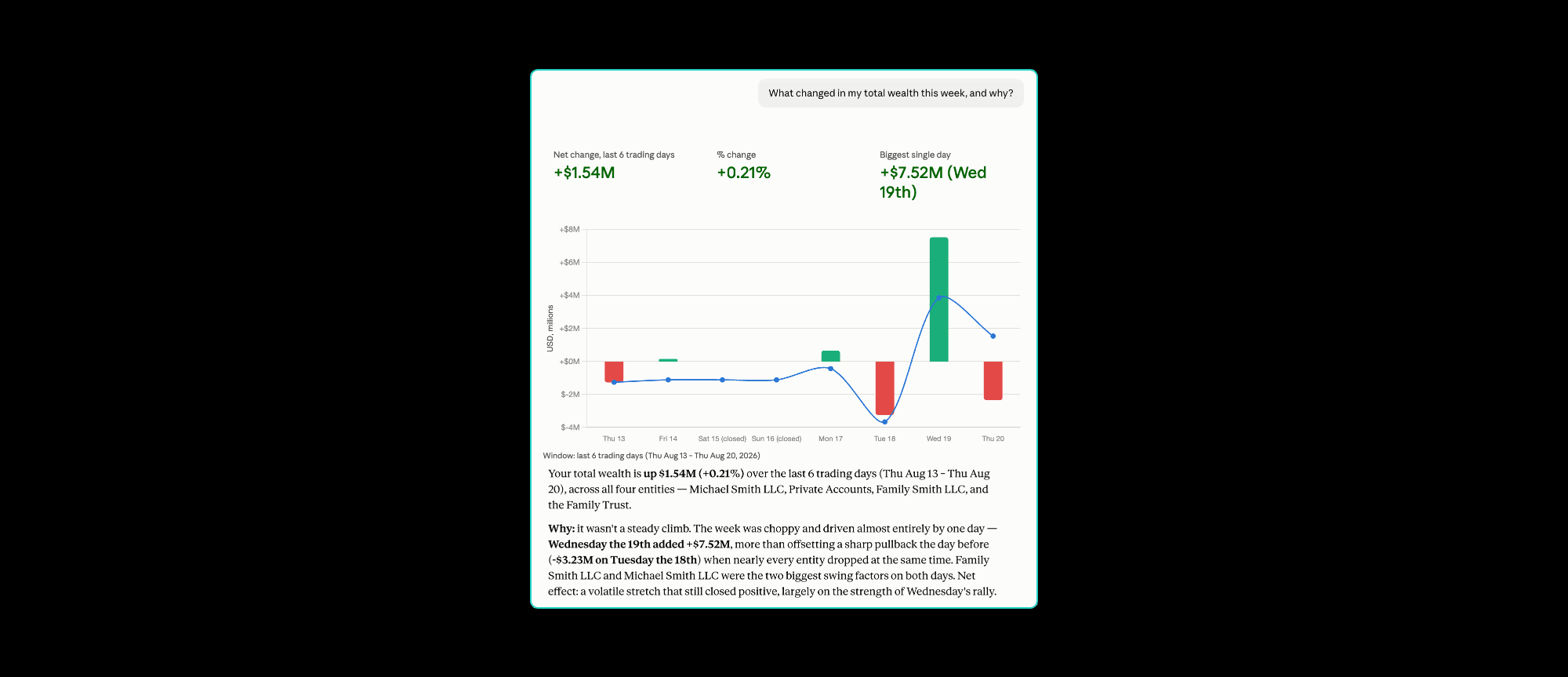
The family offices I see succeeding have stopped thinking about AI as a tool and started thinking about it as a stack. At the bottom: reconciled, machine-readable data across every custodian and asset class. One source of truth. In the middle: an open protocol layer (API and MCP) that lets any AI model access that data securely. At the top: the agents themselves, handling liquidity briefings, what-if scenarios, PE document processing, IC memos (11 prompts family offices actually run on their wealth data are documented here). Many offices try to start at the top. The ones succeeding started at the bottom.
Dreamers Collective, a multi-family office built by entrepreneurs, is a good example. They used Aleta as their structured data engine, connected custom AI agents via Aleta's API and MCP, and reduced manual data processing by 85–90%. As their principal put it: "Without structured data, AI is hallucinating. With Aleta, it is precise." (Read the full case study)
How to Actually Get Started With AI in a Family Office
The families making progress started before they had all the answers. They started with the unglamorous work: fix your data before you buy AI, treat deployment as a leadership decision rather than an IT project, and target the boring, expensive processes first. That is where AI pays off first, not in the impressive-looking use cases.
At Aleta, we sell the foundation AI needs to actually work: reconciled, structured data delivered through open architecture, so families can connect their own agents to their own data and keep full control of it. Our principle is simple: be AI-ready, not AI-dependent.
Family offices everywhere are wrestling with the same questions: where to start, how to keep data secure, how to avoid ending up with five disconnected systems that each claim to have AI. There is no shortage of appetite. What people want is a clearer path forward.
And that path starts at the bottom of the stack, not the top.
Fix your data. Choose open architecture. Make it a leadership decision.
The AI will follow.
FREE DEMO
Schedule a demo to see how Aleta delivers an intuitive, verified picture of total wealth for the Principal, deep investment reporting for the teams overseeing the wealth, and an open data layer built for the age of AI.

Frequently Asked Questions About AI in Family Offices
What is the biggest barrier to AI adoption in family offices?
What is the biggest barrier to AI adoption in family offices?
The biggest barrier is not AI itself — it is the data layer underneath it. Most family offices have data that is either fragmented across custodians, GPs, and spreadsheets, or consolidated but locked inside a closed vendor platform. Without structured, reconciled, machine-readable data, AI cannot deliver reliable results.
How many family offices are actually using AI today?
How many family offices are actually using AI today?
According to the Campden Wealth / RBC 2025 North America Family Office Report, 63% of family offices want to use AI in investment reporting, but only 29% actually do. Around 57% use AI for investment research and roughly half for due diligence, but in core operational workflows, most offices are still between experimentation and deployment.
What is MCP and why does it matter for family offices?
What is MCP and why does it matter for family offices?
MCP (Model Context Protocol) is a universal standard for connecting AI to data, now adopted by OpenAI, Google, Microsoft, AWS, and Anthropic. It allows family offices to build once and connect to any AI model without vendor lock-in. Platforms including Aleta, PitchBook, Morningstar, and LSEG have launched MCP integrations, making portfolio analytics, private market intelligence, and public market data directly accessible to AI agents.
What should a family office do before investing in AI tools?
What should a family office do before investing in AI tools?
Three things. First, fix your data — consolidate and reconcile it across all custodians and asset classes into one structured, machine-readable source of truth. Second, choose open architecture over closed platforms so you can connect your own AI agents to your own data. Third, treat AI deployment as a leadership decision, not an IT project, and start with the manual, repetitive processes that cost your team the most time.
What does an AI-ready technology stack look like for a family office?
What does an AI-ready technology stack look like for a family office?
It has three layers. At the base: consolidated, reconciled data across every custodian and asset class — one source of truth. In the middle: an open protocol layer (API and MCP) that lets any AI model access that data securely. At the top: AI agents that handle workflows like liquidity briefings, what-if scenarios, PE document processing, and IC memos. The key insight is to build from the bottom up, not the top down.
What is the difference between AI-ready and AI-dependent?
What is the difference between AI-ready and AI-dependent?
AI-ready means your platform works without AI, but your data is structured, machine-readable, and accessible so that when you are ready to deploy AI agents, the foundation is already in place. AI-dependent means your workflows rely on a specific vendor's AI features and you cannot connect your own models or agents to your own data. Aleta helps family offices become AI-ready — giving family offices full control over their data and their AI strategy.
Reads selected for you

AI Vendor Security Due Diligence Questions for Family Offices in 2026
AI vendor security due diligence questions family offices should ask in 2026 before connecting AI to wealth data, what good answers look like, and red flags.
Sep 29, 2026
AI,
Family offices

Is It Safe to Connect an AI Assistant to Family Office Data in 2026?
Aleta on what to check on training, retention, permissions, and logs before you connect.
Sep 28, 2026
AI,
Family offices
Real Prompts You Can Steal: How Family Offices Use AI Agents on Their Wealth Data
11 real prompts family offices run with AI agents on wealth data, from performance and liquidity to compliance and automation, with answers and screenshots.
Aug 25, 2026
AI,
Family offices