The Aleta API & MCP: Building a Future-Proof Tech Stack – Q&A with CEO Nordics, Anders Viskum
Discover how Aleta’s API and MCP give family offices secure, real-time data access, automation capability, and full flexibility to build a future-proof tech stack.
Dec 03, 2025
AI,
Family offices



At Aleta, most of our clients rely on the platform’s built-in dashboards and reporting to meet 90% of their needs. But some offices need more. Whether it’s syncing with internal tools, building custom workflows, or integrating with third-party systems, these clients turn to the open API, Data Cube, and MCP layer of Aleta’s family office software.
To learn more, I spoke with Anders Viskum, CEO Nordics, about our open API and MCP layer, who they’re for, and what becomes possible when you use them.
What is the Aleta API?
Isabella: Anders, let’s start simple. What exactly is the Aleta API?
Anders: The API is what allows systems to talk to each other. It’s what allows wealth data to flow seamlessly between platforms whether that’s accounting, CRM, BI tools, or something custom. It’s the same secure connection our own frontend uses to power the platform you see. When clients connect through the API, they’re accessing that same real-time data engine.
The API is publicly documented at docs.aleta.io, but access is permission-based and client-only. It’s a fully secure, enterprise-grade integration layer.
And What Is the MCP?
Isabella: And what about the MCP? How does that fit into the picture?
Anders: The MCP builds directly on top of the API. It’s designed for advanced automation and intelligent integrations, particularly those involving AI agents.
Where the API handles the secure data connection, the MCP layer standardizes the way information flows in and out, making it machine-readable and automation-ready. It gives AI tools the structure they need to understand how to interact with Aleta.


Why Does It Matter?
Isabella: What are the biggest benefits of using the API and the MCP?
Anders: The core benefit is automation. Instead of exporting data manually or maintaining the same information in multiple systems, the API allows Aleta to speak directly with your other systems or the other way around.
And because it uses structured JSON format, the data is ready for direct use in other systems with no cleaning, reformatting, or translating.
You save time, reduce errors, and can build exactly the workflows your organization needs.
When you layer on the MCP, you can automate even more complex workflows. That’s especially valuable for offices experimenting with AI or building proprietary digital assistants.
For tech-forward family offices, it’s a massive unlock.
Who Uses It? And When?
Isabella: Who typically makes use of the API and MCP?
Anders: Mostly the more tech-forward family offices that want to integrate Aleta into a broader ecosystem and have their own internal developers or an IT team to connect the dots across systems.
For example, one client pulls private equity transaction data from Aleta directly into their internal analytics engine, where they do custom forecasting and other specific analyses. Another client connects Aleta to their CRM and accounting systems to create a fully synchronized view.
And we’ve got a client who uses a webhook integration that allows their advisors to trigger real-time portfolio actions from inside Aleta, even though Aleta itself isn’t a trading platform. That’s the power of open modular architecture.
For those exploring AI, the MCP brings this to another level. One client built an AI assistant that understands commands like “log a new PE transaction.” Because it’s layered on the MCP which is built on top of our well-documented API, the bot knows how to handle the request, validate the fields, and interact with Aleta securely. It’s fast, accurate, and structured.
For clients without in-house developers, the Aleta Data Cube is often a better fit than the API because it doesn’t require any coding. But for those who do have the resources, the API and the MCP opens up a high level of flexibility and control.


FREE DEMO
Schedule a demo to see how Aleta delivers an intuitive, verified picture of total wealth for the Principal, deep investment reporting for the teams overseeing the wealth, and an open data layer built for the age of AI.

API vs. Data Cube – What’s the Difference?
Isabella: How does the API differ from the Aleta Data Cube?
Anders: Good question. The API is for system-to-system communication. It’s how you embed Aleta data into your own tools or infrastructure. You use it when you want to automate, integrate, or build additional layers on top of Aleta.
The Data Cube, on the other hand, is designed for power users – people who want to analyze live data in Excel or Power BI without any coding. You simply connect the Data Cube directly to your preferred BI tool where you can create any report you want simply by dragging and dropping. With no need for an API.
Both are ways to access your data. The difference is who’s using it – and what they’re trying to build.
What Makes Aleta’s API and MCP Unique?
Isabella: Many platforms offer APIs. What makes Aleta’s offering stand out?
Anders: Three things.
First, the API is truly usable. It’s thoroughly documented and easy for developers to work with. And when paired with our MCP, it unlocks a level of automation most platforms simply can’t offer. Especially when it comes to structured, AI-ready workflows.
Second, the security is enterprise-grade. All access is encrypted, permissioned, and governed by the same standards we apply across the Aleta ecosystem.
Third, flexibility. It’s the same API our own platform uses internally, so clients aren’t limited to “safe” or partial access. If it exists in your Aleta environment, you can connect to it.
Final Thoughts
Isabella: Any closing advice related to our API?
Anders: Yes, and I’ll start with what’s most important: most family offices will find that Aleta’s built-in dashboards and reporting cover the vast majority of their needs. That’s by design. The platform is intuitive, comprehensive, and ready to use on day one.
But for those who want full control, who want to build custom workflows, connect external systems, or automate beyond the surface, the API opens up a new dimension.
And for those pushing into AI, the MCP is foundational. It’s what turns Aleta into a programmable, intelligent component of your broader tech stack.
It provides family offices with long-term flexibility.
Together, the Aleta API and MCP give you the freedom to design your own reporting future, knowing that as your needs evolve, your platform evolves with you.
Isabella: Thanks, Anders.
Anders: Always a pleasure.
In Summary
While Aleta’s dashboards meet most reporting needs out of the box, our open architecture ensures you’re never limited. The Aleta API – and for advanced cases, the MCP layer – gives family offices full freedom to integrate, automate, and scale on their terms.
To recap, the Aleta API and MCP offer:
Secure, real-time access to consolidated, reconciled, structured wealth data.
Seamless integration with systems such as CRM, ERP, or internal custom tools.
A foundation for intelligent automation and AI-driven workflows.
Enterprise-grade security and full documentation.
Freedom to build workflows, dashboards, and forecasts on your terms.
With Aleta’s open architecture, you’re never boxed in. Whether you use the native platform, the Data Cube, the API, or the MCP layer, you’re always in control and ready for the future.
Want to see the API in action? Visit docs.aleta.io or reach out. We’d be happy to walk you through it.
You might like these reads

AI Vendor Security Due Diligence Questions for Family Offices in 2026
AI vendor security due diligence questions family offices should ask in 2026 before connecting AI to wealth data, what good answers look like, and red flags.
Sep 29, 2026
AI,
Family offices

Is It Safe to Connect an AI Assistant to Family Office Data in 2026?
Aleta on what to check on training, retention, permissions, and logs before you connect.
Sep 28, 2026
AI,
Family offices
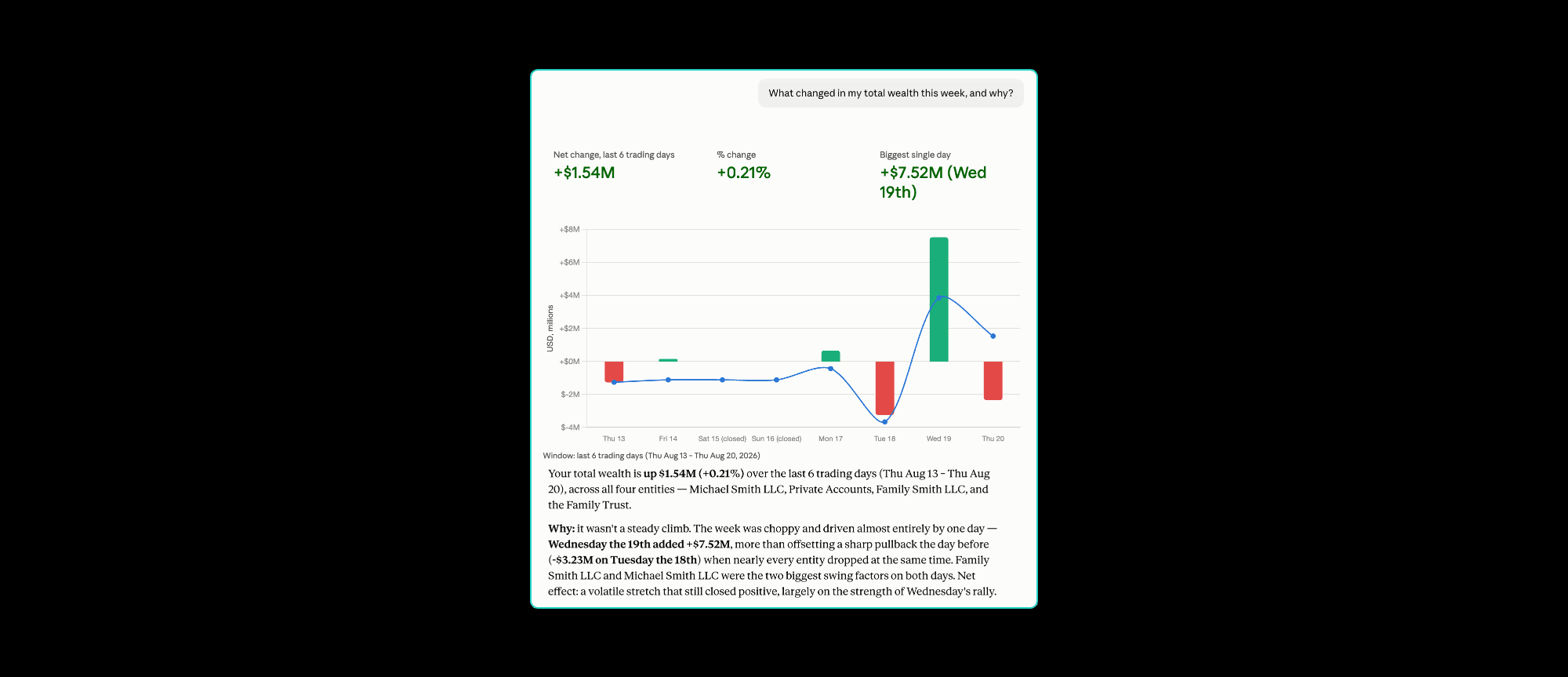
Real Prompts You Can Steal: How Family Offices Use AI Agents on Their Wealth Data
11 real prompts family offices run with AI agents on wealth data, from performance and liquidity to compliance and automation, with answers and screenshots.
Aug 25, 2026
AI,
Family offices