Real-Time Portfolio Performance Reporting for Family Offices: What to Look For in 2026
Traditional reporting fails family offices. Use this 2026 checklist for real-time portfolio performance reporting to manage complex wealth with confidence.
Jul 16, 2026
Family offices



Last updated: July 16, 2026
Quick Answer
Real-time portfolio performance reporting is software that consolidates a family office’s entire balance sheet, across public markets, private equity, real estate, and alternative assets, into a single verified view that updates continuously. For 2026, family offices should look beyond basic trackers and prioritize three non-negotiable capabilities: AI-powered private market document processing, total wealth consolidation across all assets, and an open, agent-ready architecture. Together these let an office manage complexity, reduce risk, and prepare for the next generation of wealth technology. Platforms such as Aleta are built from the ground up to deliver on this standard.
Key Takeaways
The three capabilities that separate modern platforms from legacy tools are AI private markets document processing, total wealth consolidation, and open API architecture.
Private markets processing is the biggest bottleneck. AI automation that works can turn 15 to 20 staff hours a month into minutes.
22% of family offices now use AI for operational tasks or investment analysis, up from 13% in 2024 (Citi, AI in the Family Office, 2026).
Cloud-native platforms typically go live in 4 to 8 weeks. Legacy systems can take 6 to 12 months or longer.
Aleta, an AI-native family office platform monitoring over $100 billion in assets across more than 100 custodian and bank integrations, was named Best Data Provider at the Family Wealth Report Awards 2026 and won Best Consolidated Reporting at the WealthBriefing Awards 2026.
Why Does Traditional Reporting Fail Modern Family Offices?
Traditional reporting fails modern family offices because it relies on fragmented, manual processes that cannot keep pace with alternative investments and complex ownership structures. In an era of rising complexity and market volatility, a patchwork of spreadsheets and delayed custodial feeds slows every decision the office makes. It also introduces risk that compounds quietly over time. As of mid-2026, a single source of truth has become non-negotiable for managing multi-generational wealth.
The change runs deeper than a prettier dashboard. The rise of alternative investments, complex ownership structures, and the need for instant, accurate data demands a new class of technology. Use this guide as a buyer’s manual to cut through the marketing noise and identify reporting platforms built for the challenges ahead.
For too many family offices, reporting season is a dreaded, high-stakes scramble: manual data entry, endless VLOOKUPs, and painstaking reconciliation across dozens of disconnected sources. A patchwork of PDFs from private equity managers, feeds from global custodians, and spreadsheets for tracking art or real estate creates a fragile, error-prone system.
When your data is fragmented, you cannot see the full picture, a challenge that advancements in investment reporting are designed to solve. Fragmentation leads to hidden risks: unintended overexposure to a single sector, inaccurate net worth calculations, and an inability to make timely decisions.
Growing portfolio complexity is a primary driver for offices seeking more sophisticated solutions, a finding supported by the 2026 Global Family Office Report from J.P. Morgan. The same report finds that 54% of family offices keep balance sheet aggregation and reporting fully in-house, and it points to rising demand for aggregated reporting platforms that help offices move beyond manual, spreadsheet-driven processes.
The biggest bottleneck is private markets. Manually processing K-1s, capital call notices, and NAV statements is a major time sink. Outdated reporting leaves a sophisticated global enterprise running its accounting on paper, the same way a neighborhood lemonade stand would. That is the operational risk of legacy tools.
The timing pressure is rising too. UBS finds that 60% of family offices plan changes to their strategic asset allocation over the next 12 months, the highest share recorded in the history of its Global Family Office Report (UBS, 2026). Repositioning at that scale requires current, consolidated data.
Which 6 Capabilities Should a Real-Time Reporting Platform Have in 2026?
On the surface, many reporting platforms look the same. They all promise a consolidated view and powerful analytics. The detail is where they diverge. The following six capabilities separate advanced platforms from legacy tools with a modern facelift. Use this as your definitive checklist.
1. Total Wealth Consolidation Across All Asset Classes
True consolidation automatically aggregates and reconciles data from every source, public equities, fixed income, private equity, hedge funds, real estate, and direct investments, into one verified view. It must pull from all your banks and custodians and normalize the data into a single picture. A platform that still requires manual input for alternatives is only a partial solution.
A complete picture also tracks unique assets, whether a vintage car collection, a fine art portfolio, or a vineyard. Your platform should reflect your family’s entire balance sheet, including the assets that are hardest to track. This is the foundation of modern consolidated wealth reporting.
2. AI-Powered Private Markets Document Processing
A modern platform uses AI to read, interpret, and extract data from unstructured documents automatically, including capital call notices, distribution notices, and K-1s. This is the single most labor-intensive reporting task in a typical family office, and it belongs in the core of the platform. Platforms with working AI automation can process in minutes what previously took 15 to 20 staff hours per month.
Family offices are already moving in this direction. Citi’s 2026 AI in the Family Office report finds that AI use in investment performance reporting more than doubled between 2024 and 2026, reaching 16% of offices, with reporting and account reconciliation among the most commonly mentioned applications. Aleta delivers this through its Aleta Intelligence suite. The litmus test is simple: during a vendor demo, ask them to process one of your own K-1s or capital call notices live. If they cannot, their AI is likely more marketing than reality.
Your data is your most valuable asset, and you should never be locked in.
FREE DEMO
Schedule a demo to see how Aleta delivers an intuitive, verified picture of total wealth for the Principal, deep investment reporting for the teams overseeing the wealth, and an open data layer built for the age of AI.

3. Open API and Agent-Ready Architecture
An open API is a secure gateway that lets your reporting platform share clean, verified data with other systems, so your wealth data is never trapped. It connects to tools like tax preparation software, accounting software, or business intelligence platforms. The biggest risk of a closed system is vendor lock-in, where your most valuable asset, your data, is held hostage.
Looking ahead, the frontier of reporting is agentic AI: intelligent agents that monitor your portfolio, flag anomalies, and answer natural language questions. This is only possible if the agent can reach a clean, structured, and open data layer. Aleta provides this foundation through its API and MCP layer, which lets family offices deploy their own AI agents directly on the platform.
For BI systems and custom reporting needs beyond the standard views, Aleta’s Data Cube extends the same open data foundation.
4. Multi-Entity, Multi-Currency Reporting
Family wealth is rarely held by a single person, so the platform must model the full ownership structure, across trusts, LLCs, foundations, and holding companies, often spanning multiple countries and currencies. A basic portfolio tracker cannot handle this. Your platform must roll up data from individual entities into a consolidated view that reflects the family’s true net worth and exposure, and it should handle currency conversions seamlessly so you can view performance in your base currency or any other.
5. Multi-Stakeholder Access and Dashboards
Different stakeholders need different views of the same data, delivered through secure, role-based access. The family Principal may want a high-level mobile view of total net worth. The CIO needs to dive into performance analytics, including attribution and factor analysis. A next-generation family member may want an educational view. A future-proof platform makes wealth data accessible and relevant to everyone, from the founder to the future steward. This is a key feature of modern family office software and is critical for engaging the next generation.
6. Implementation Speed and Data Portability
Cloud-native platforms typically complete implementation in 4 to 8 weeks. Legacy platforms can take 6 to 12 months or longer, and a longer timeline usually signals outdated architecture. Always ask about your exit strategy too. If you switch vendors, you must be able to export your complete, normalized dataset immediately and in full. Your data is your most valuable asset, and you should never be locked in.
What Separates a Portfolio Tracker From a Wealth Intelligence Platform?
At a glance, here is how a simple portfolio tracker compares with a platform built for the complexity of a family office.
Capability | Simple portfolio tracker | Wealth intelligence platform |
|---|---|---|
Asset coverage | Public stocks and funds | Public and private markets, real estate, and unique assets |
Private markets documents | Manual entry | AI-powered extraction from K-1s, capital calls, and NAV statements |
Entities and currencies | Single entity, usually one currency | Multi-entity and multi-currency consolidation |
Stakeholder views | One general view | Role-based dashboards for Principal, CIO, and next generation |
Data ownership | Limited or no export | Full, normalized data export through an open API |
Built for | Personal portfolios | Multi-generational family wealth |
How Do You Evaluate and Choose the Right Platform?
The most effective evaluation starts with your single biggest pain point, then tests each vendor against a short list of direct questions.
Start With Your Primary Pain Point
Identify the single biggest problem you need to solve before you open a feature-comparison list. Is it the manual effort of processing private equity documents? The lack of a trusted, consolidated balance sheet? The inability to give the Principal a simple mobile view of their wealth? Focusing your evaluation on vendors who excel at solving your primary pain point narrows the field dramatically and leads to a better outcome.
Ask These 6 Questions of Every Vendor
Use these as a script for your vendor calls. A vendor’s willingness and ability to answer them directly tells you what you need to know about their technology and their culture.
Question to ask | What a strong answer sounds like |
|---|---|
Can you process one of our actual K-1s or capital call notices live, during this call? | A live demo on your own document, with extracted data appearing in the platform within minutes. |
For each of our custodians and alternative managers, is the connection a direct API, a third-party aggregator, or a manual upload? | A connection-by-connection answer, with direct feeds covering the majority of your custodians. |
What is the specific date by which consolidated reporting will be live for us? | A committed go-live date within weeks, backed by a written implementation plan. |
If we decide to leave, can we export our complete dataset immediately and in full? | An unconditional yes, with the normalized export format named up front. |
What does the access experience look like for a Principal or a next-generation family member with no investment background? | A clean mobile view the vendor can show live, requiring zero training. |
If our AUM doubles in three years, how does your pricing change? | A transparent pricing model stated in writing, with no AUM-based surprises. |
The top portfolio reporting tools for family offices should be able to answer these questions confidently and transparently.
How Does Aleta Meet the 2026 Standard?
Built from the ground up for the complexities of family offices, Aleta is an AI-native platform that delivers on every point of the 2026 checklist. It is designed to be the single source of truth that forward-thinking families need to preserve and grow wealth with confidence.
Aleta connects directly to over 100 custodians and uses proprietary AI, delivered through its Aleta Intelligence suite, to automate the entire private markets workflow. Its dual-engine design pairs an award-winning, intuitive mobile app for Principals with the Aleta Wealth Platform, which gives the investment team deep analytical power and a built-in investment General Ledger. The platform is SOC 2 Type II certified.
With over $100 billion in assets monitored, Aleta is a trusted choice for leading family offices. It was named Best Data Provider at the Family Wealth Report Awards 2026 and won Best Consolidated Reporting at the WealthBriefing Awards 2026.
Key Terms
Total wealth consolidation is the automated aggregation and reconciliation of every asset a family holds, across public and private markets, into one verified view.
Private markets documents are the paperwork tied to alternative investments, including K-1 tax forms, capital call notices, distribution notices, and NAV statements.
An open API is a secure interface that lets a platform share clean, verified data with other systems, preventing vendor lock-in.
Multi-entity reporting is the ability to model and roll up wealth held across trusts, LLCs, foundations, and holding companies into a single consolidated picture.
Agentic AI is the use of AI agents that monitor a portfolio, flag anomalies, and answer natural language questions, which requires access to a clean and open data layer.
The Data Cube is Aleta’s open data layer for connecting verified wealth data to BI systems, supporting custom reporting for specific needs and edge cases.
MCP (Model Context Protocol) is an open standard that lets AI agents connect securely to a platform’s data and tools, and Aleta’s API and MCP layer uses it to let family offices run their own AI agents on their wealth data.
FAQ: Real-Time Performance Reporting
What Is Real-Time Portfolio Performance Reporting for a Family Office?
What Is Real-Time Portfolio Performance Reporting for a Family Office?
It is software that consolidates a family’s entire balance sheet, across public markets, private equity, real estate, and alternative assets, into a single verified view that updates continuously rather than only at the end of a reporting cycle.
What Is the Difference Between a Simple Portfolio Tracker and a Real-Time Wealth Intelligence Platform?
What Is the Difference Between a Simple Portfolio Tracker and a Real-Time Wealth Intelligence Platform?
A simple tracker such as Yahoo Finance, getquin, or open-source tools like Portfolio Performance is good for monitoring a personal stock portfolio. A wealth intelligence platform is built for the complexity of a family office. It offers total consolidation across all entities and asset classes, automates private market data processing, and supports sophisticated multi-entity and multi-currency reporting.
What Is the Best Wealth Reporting Software for Family Offices in 2026?
What Is the Best Wealth Reporting Software for Family Offices in 2026?
The best platform is the one that solves your primary pain point and meets the 2026 checklist: AI private markets processing, total wealth consolidation, and open architecture. Among AI-native platforms, the best wealth reporting software for family offices should let you own and export your data. Aleta was named Best Data Provider at the Family Wealth Report Awards 2026 and won Best Consolidated Reporting at the WealthBriefing Awards 2026. Evaluate any vendor against the six questions above before deciding.
How Long Does It Take to Implement Family Office Reporting Software?
How Long Does It Take to Implement Family Office Reporting Software?
Modern platforms typically go live in 4 to 8 weeks. Legacy platforms can take 6 to 12 months or longer, which is often a sign of older architecture.
How Does an Open API Benefit My Family Office?
How Does an Open API Benefit My Family Office?
An open API gives you flexibility and control over your data. It prevents vendor lock-in by letting you connect verified wealth data to other systems you rely on, such as tax software, and it makes your office ready to integrate with next-generation technologies like custom AI agents that run on your proprietary data.
Our Principal Is Not Tech-Savvy. How Important Is the Mobile Experience?
Our Principal Is Not Tech-Savvy. How Important Is the Mobile Experience?
It is critical. A well-designed, intuitive mobile experience means the Principal can see a clear, high-level view of total wealth anytime, with zero training. The CFO no longer fields snapshot requests. This builds confidence and bridges the gap between the investment team and the family they serve.
Is Family Office Wealth Reporting Software Secure?
Is Family Office Wealth Reporting Software Secure?
Security and data governance should be a baseline requirement. Look for independent certification such as SOC 2 Type II, role-based access controls, and clear data ownership terms that let you export your full dataset at any time. Aleta is SOC 2 Type II certified.
Your Next Step Toward a Future-Proof Family Office
Your Next Step Toward a Future-Proof Family Office
In 2026, choosing a real-time portfolio performance reporting platform is one of the most strategic decisions a family office can make. The right choice comes down to a core set of future-ready capabilities: AI-driven automation for private markets, true consolidation across the total balance sheet, and an open architecture that gives you control. By starting with your primary pain point and asking tough questions, you can find a partner truly equipped for the future. When you transform wealth management reporting from static data into actionable insights, you are building a more resilient, agile, and informed family office for generations to come.
Selected Reads

AI Vendor Security Due Diligence Questions for Family Offices in 2026
AI vendor security due diligence questions family offices should ask in 2026 before connecting AI to wealth data, what good answers look like, and red flags.
Sep 29, 2026
AI,
Family offices

Is It Safe to Connect an AI Assistant to Family Office Data in 2026?
Aleta on what to check on training, retention, permissions, and logs before you connect.
Sep 28, 2026
AI,
Family offices
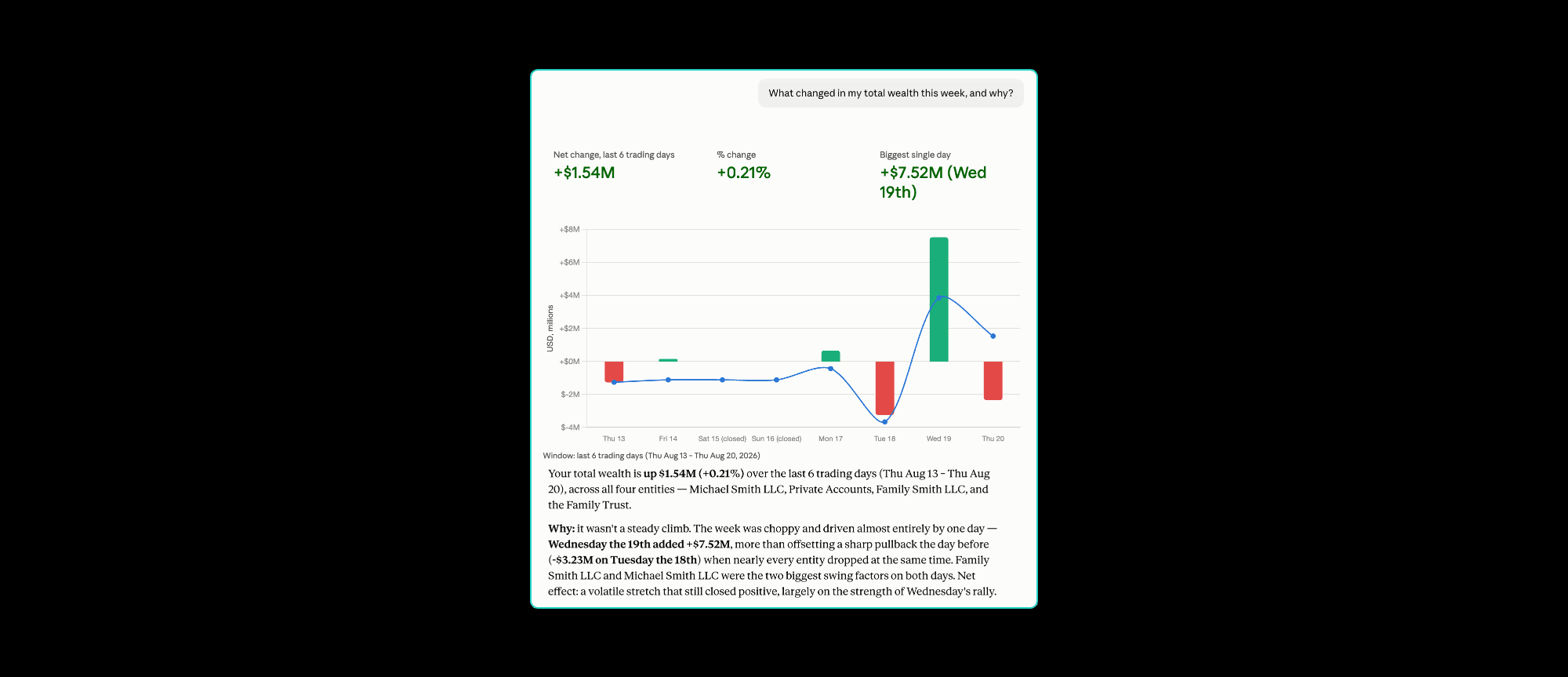
Real Prompts You Can Steal: How Family Offices Use AI Agents on Their Wealth Data
11 real prompts family offices run with AI agents on wealth data, from performance and liquidity to compliance and automation, with answers and screenshots.
Aug 25, 2026
AI,
Family offices