Best Accounting Software for Family Offices in 2026: Top 7
A practical guide to the best General Ledgers for family offices. Compare Asseta AI, SumIt, Sage, Yardi, and NetSuite. Learn how to build a Best-of-Breed tech stack.
Jan 05, 2026
Family offices



Last updated: September 16, 2026.
Executive Summary: The Rise of the Dedicated Family Office GL
The Rise of Purpose-Built Tech: For years, family offices were forced to choose between simplistic tools (QuickBooks) or massive enterprise ERPs (NetSuite). In 2026, a positive market shift has occurred with the emergence of dedicated Family Office GLs like SumIt and Asseta AI. These platforms solve specific industry pain points, like rapid multi-entity consolidation, without the "bloat" of generic enterprise software.
The Intelligence Gap: While a robust General Ledger is essential for data integrity, it is not designed for strategic oversight. Leading family offices now distinguish clearly between the Accounting Engine (System of Record) and the Wealth Intelligence Layer (System of Engagement).
The "Best-of-Breed" Stack: Instead of trying to force accounting software to act as a portfolio dashboard, the modern standard is pairing a specialized best-in-class GL with a dedicated Wealth Intelligence Platform (like Aleta) via Open APIs. This delivers both audit-ready precision and a total, strategic view of wealth.
Quick Comparison: Top 7 Family Office Accounting Platforms
Platform | Primary Focus | Best For |
|---|---|---|
Asseta AI | Family office ops & GL. | Operations teams needing an AI-driven banking & bill pay engine. |
SumIt | Modern family office GL. | Finance teams seeking speed and rapid multi-entity consolidation. |
AgilLink | Bill pay & accounting. | Business Managers needing legacy-style specialized bill pay. |
Sage Intacct | Cloud accounting. | The CFO’s choice for robust multi-entity financial management. |
Oracle NetSuite | Enterprise ERP. | Large, complex offices requiring heavy customization and global scale. |
Yardi Voyager | Real estate ERP. | Real estate-heavy offices managing property operations directly. |
QuickBooks | General accounting. | Early-stage offices or individual entities requiring simplicity. |
The "If This, Then That" Decision Matrix
Don't have time to read the full reviews? Here's the strategic cheat sheet for 2026:
If | Then |
|---|---|
If you are a Finance-led office prioritizing speed: | Choose SumIt (for rapid close) + Aleta. |
If you are an Operations-focused office: | Choose Asseta AI (for automated bill pay/banking) + Aleta (for intelligence). |
If you are a Real Estate heavy office: | Choose Yardi Voyager (for property ops) + Aleta (for total wealth overview). |
If you need a traditional "Business Management" tool: | Choose AgilLink (for legacy banking integration). |
If you are a massive Global Enterprise: | Choose Oracle NetSuite (for unlimited scale). |
If you manage a simple Holding Company: | Choose QuickBooks (keep it simple). |
Introduction: A Maturing Market
The family office technology landscape has matured significantly. Just a few years ago, finance teams often had to "hack" small business software to handle complex trusts or endure year-long implementations of massive corporate ERPs.
The "Legacy" Problem
Before 2026, most family offices were stuck using small business tools that couldn't handle trusts, or massive corporate ERPs that took 12 months to implement. The platforms below represent the new era of "Purpose-Built" technology.
Today, the emergence of specialized General Ledgers, specifically designed for the nuances of multi-entity wealth structures, is a game changer. Platforms like SumIt and Asseta AI prove that the industry creates enough demand to support dedicated solutions. This allows family offices to finally adopt software that fits their specific operational reality.
Below, we review the top 7 platforms defining this new standard.
What Family Offices Need from Accounting Software
While platforms vary in focus, the most effective accounting solutions for family offices share a common set of capabilities:
Multi-entity support: The ability to handle complex structures (LLCs, Trusts, HoldCos) seamlessly without manual workarounds.
Audit trails: Strong functionality with approvals, segregation of duties, and evidence retention to satisfy governance requirements.
Intercompany transactions: Reliable handling of allocations, eliminations, and shared expense methodologies across entities.
Open Integrations: Connectivity with banks, custodians, and wealth platforms via APIs or file feeds.
Controls: Features that support close management, exception handling, and variance review workflows.
Importantly, accounting systems are designed to record and control financial activity. They are not typically built to provide holistic visibility across all asset classes or to deliver intuitive, principal-facing reporting. That gap is where integration matters most.
FREE DEMO
Schedule a demo to see how Aleta delivers an intuitive, verified picture of total wealth for the Principal, deep investment reporting for the teams overseeing the wealth, and an open data layer built for the age of AI.

1. Asseta
Primary Focus: Family office accounting & Ops
Best For: Operations teams seeking an AI-driven banking & GL engine that integrates with wealth overlays.
Asseta is a family office-focused accounting and operations platform designed to master financial workflows through intelligent automation. It combines general ledger accounting with integrated banking and bill pay. Asseta is widely viewed as the modern successor to legacy bill-pay systems, using AI to streamline high-volume financial tasks while offering superior API connectivity.
The Verdict
A powerhouse for the operational side. Asseta excels at the daily "plumbing" – banking, bill pay, and accounting – by leveraging automation to reduce manual work. It is frequently deployed as the operational engine alongside a wealth platform like Aleta, creating a stack where Asseta handles the rigorous financial data and Aleta delivers the strategic overview.
2. SumIt
Primary Focus: Modern family office GL
Best For: Finance teams seeking a specialized General Ledger to accelerate multi-entity consolidation.
SumIt is a specialized accounting platform built specifically to conquer the multi-entity complexity of family offices. It targets the specific bottleneck of "closing the books," allowing finance teams to consolidate hundreds of entities significantly faster than with legacy tools. It is designed with a philosophy of specialization, aiming to be the market's most efficient accounting engine.
The Verdict
An exceptional, specialized solution for the finance team. SumIt creates a high-speed, accurate accounting layer that solves the "back-office" headache. It is the ideal GL partner to power platforms like Aleta, allowing offices to combine SumIt’s accounting speed with Aleta’s comprehensive visualization.
3. AgilLink (Datafaction)
Primary Focus: Bill pay & accounting
Best For: Business Managers needing legacy-style specialized bill pay.
AgilLink (formerly Datafaction) is a specialized accounting and bill payment solution widely used by business managers and family offices, particularly in the entertainment industry. Owned by City National Bank, it focuses heavily on secure bill payment workflows and basic accounting for HNWIs.
The Verdict
The "Old Guard" of bill pay. AgilLink is a trusted, secure industry standard that handles cash management well. However, its legacy architecture can feel dated compared to modern AI-driven alternatives (like Asseta AI), and it is best suited for offices that prioritize banking integration over modern API flexibility.
4. Sage Intacct
Primary Focus: Cloud accounting
Best For: The CFO’s choice for robust multi-entity financial management.
Sage Intacct is a best-in-class cloud financial management platform widely used by family offices that require strong financial controls and audit-ready reporting. The platform is known for its depth in core accounting, multi-entity consolidation, and compliance support. Its dimensional accounting model allows transactions to be tagged across multiple dimensions such as entity, department, or project.
The Verdict
A top-tier choice for the "Office of the CFO." Sage Intacct offers a perfect balance of power and usability for finance professionals. It is a pure-play accounting system that pairs exceptionally well with family office software like Aleta.
5. Oracle NetSuite
Primary Focus: Enterprise ERP & accounting
Best For: Large, complex offices requiring heavy customization and global scale.
Oracle NetSuite is a cloud-based ERP and accounting platform used by complex organizations with enterprise-level needs. NetSuite is known for its breadth, offering core accounting alongside modules for consolidation, planning, and operational management. Its ability to support highly customized workflows and large entity counts makes it suitable for offices with institutional-style finance teams.
The Verdict
The "Gold Standard" for large-scale enterprises. NetSuite can handle almost anything but comes with a high price tag and steep learning curve. It serves as an excellent, robust backend that feeds data into more user-friendly wealth platforms.
6. Yardi Voyager
Primary Focus: Real estate ERP
Best For: Real estate-heavy offices managing property operations directly.
Yardi Voyager is the industry standard for property management and accounting. It is a core system for real estate-heavy family offices, handling leasing, rent rolls, and property-level financials at scale. It is designed for offices that act as landlords or developers rather than passive investors.
The Verdict
The heavyweight champion for real estate. If your family office manages a large portfolio of commercial or residential properties directly, Yardi is indispensable for the operational details. It typically sits alongside a master wealth platform like Aleta, which aggregates the Yardi data into the total family balance sheet.
7. QuickBooks
Primary Focus: General accounting
Best For: Early-stage offices or individual entities requiring simplicity.
QuickBooks is one of the most widely used accounting platforms globally and is often the first accounting system adopted by family offices. Its popularity stems from its accessibility, ease of use, and broad familiarity among accountants. However, it is typically limited to simpler structures or individual operating entities.
The Verdict
The undisputed king of simplicity. While excellent for operating companies or simple family structures, complex multi-entity family offices often outgrow its consolidation capabilities, eventually migrating to systems like Sage, SumIt, or Asseta AI.
How to Choose an Accounting Platform
Selecting the right GL is about alignment. Consider these factors:
How complex is your entity structure?
A structure with many entities benefits from a system (like SumIt or Asseta AI) that supports multi-entity accounting and consolidated reporting natively.
How much intercompany activity runs through your organization?
Frequent intercompany transfers and shared expenses increase the value of reliable intercompany workflows and eliminations.
How connected does accounting need to be with portfolio oversight?
Teams that need tight alignment between accounting records and investment activity should prioritize platforms with open APIs. This ensures that the accounting data can flow seamlessly into a wealth intelligence platform like Aleta for holistic reporting.
The "GL + Intelligence" Strategy: How Aleta Fits
Accounting systems play a critical role in ensuring financial accuracy, control, and compliance. However, they are systems of record, designed to answer "What happened?" (past tense). They are not designed to answer "What is our total exposure?" or "How are we performing?" (strategic tense).
This is why modern family offices use Aleta alongside their accounting systems to bridge the gap between back-office data and front-office decisions.
While your chosen GL (be it Sage, SumIt, or Asseta AI) records the rigorous debits and credits, Aleta acts as the Intelligence Layer, providing three critical advantages:
1. The Unified "Total Wealth" View
A General Ledger rarely captures the full picture. It often lacks live custodial data, updated private equity NAVs, or the current market value of real estate and art.
The Aleta Advantage: Aleta pulls data not just from the GL, but also directly from custodians, banks, and private market PDFs.
The Benefit: A single, consolidated balance sheet that combines "bankable" assets with "non-bankable" assets, giving principals a true 100% view of their net worth.
2. Principal-Friendly Visualization
Accounting reports (balance sheets and P&Ls) are vital for accountants but often unintuitive for family members.
The Aleta Advantage: Aleta transforms complex accounting lines into intuitive, mobile-first dashboards.
The Benefit: Principals get a clear, visual "Command Center" on their phone, allowing them to understand their wealth without needing to decipher a spreadsheet.
3. Operational Efficiency (The Sub-Ledger Effect)
Accounting software often chokes on the volume of investment data. Bogging down a GL with thousands of individual trade confirmations slows down the close.
The Aleta Advantage: Aleta acts as a sub-ledger that aggregates and reconciles investment transactions automatically, allowing the finance team to book a single summary entry into the GL, booking to its own built-in double-entry investment general ledger before the summary reaches your GL.
The Benefit: A faster month-end close and a cleaner accounting system.
Rather than replacing accounting software, Aleta integrates with it, serving as the operating layer that transforms raw financial records into clarity and insight.
Methodology: How We Selected These Top 7
With dozens of accounting platforms on the market, we narrowed this list to the 7 most relevant for family offices in 2026. We removed generalist ERPs and outdated legacy tools to focus on systems that meet three criteria:
Specialization: Does the platform dominate its specific category (e.g., AI operations, enterprise, or real estate)?
Integration Capability: Can the GL easily push data to a wealth intelligence layer (like Aleta) via API?
Governance: Does the system support the audit trails and multi-entity controls required by high-net-worth structures?
FAQ
Why shouldn't I just use my accounting software for investment reporting?
Why shouldn't I just use my accounting software for investment reporting?
Two reasons: Complexity and visualization. First, accounting software excels at tax and book value but struggles with performance metrics like TWR or benchmarking. Second, accounting reports are often too dense for family principals. A dedicated wealth platform visualizes this data in a way that supports strategic decision-making.
Can I use multiple accounting systems in one family office?
Can I use multiple accounting systems in one family office?
Yes. It is common to use a specialized system (like Yardi) for real estate entities and a general system (like Sage or QuickBooks) for holding companies. A data aggregation platform like Aleta can unify these separate streams into one consolidated view.
What is the difference between an ERP and a GL?
What is the difference between an ERP and a GL?
A General Ledger (GL) focuses purely on financial accounting. An ERP (Enterprise Resource Planning) system, like NetSuite, includes GL but adds modules for inventory, supply chain, and CRM. Most family offices need a strong GL; only those with complex operating businesses typically need a full ERP.
How important is an open API for accounting software?
How important is an open API for accounting software?
Critical. In 2026, data needs to flow instantly from your accounting system to your reporting dashboards. Platforms with open APIs allow this to happen automatically. Without APIs, your team is stuck manually exporting and importing Excel files.
Reads selected for you

AI Vendor Security Due Diligence Questions for Family Offices in 2026
AI vendor security due diligence questions family offices should ask in 2026 before connecting AI to wealth data, what good answers look like, and red flags.
Sep 29, 2026
AI,
Family offices

Is It Safe to Connect an AI Assistant to Family Office Data in 2026?
Aleta on what to check on training, retention, permissions, and logs before you connect.
Sep 28, 2026
AI,
Family offices
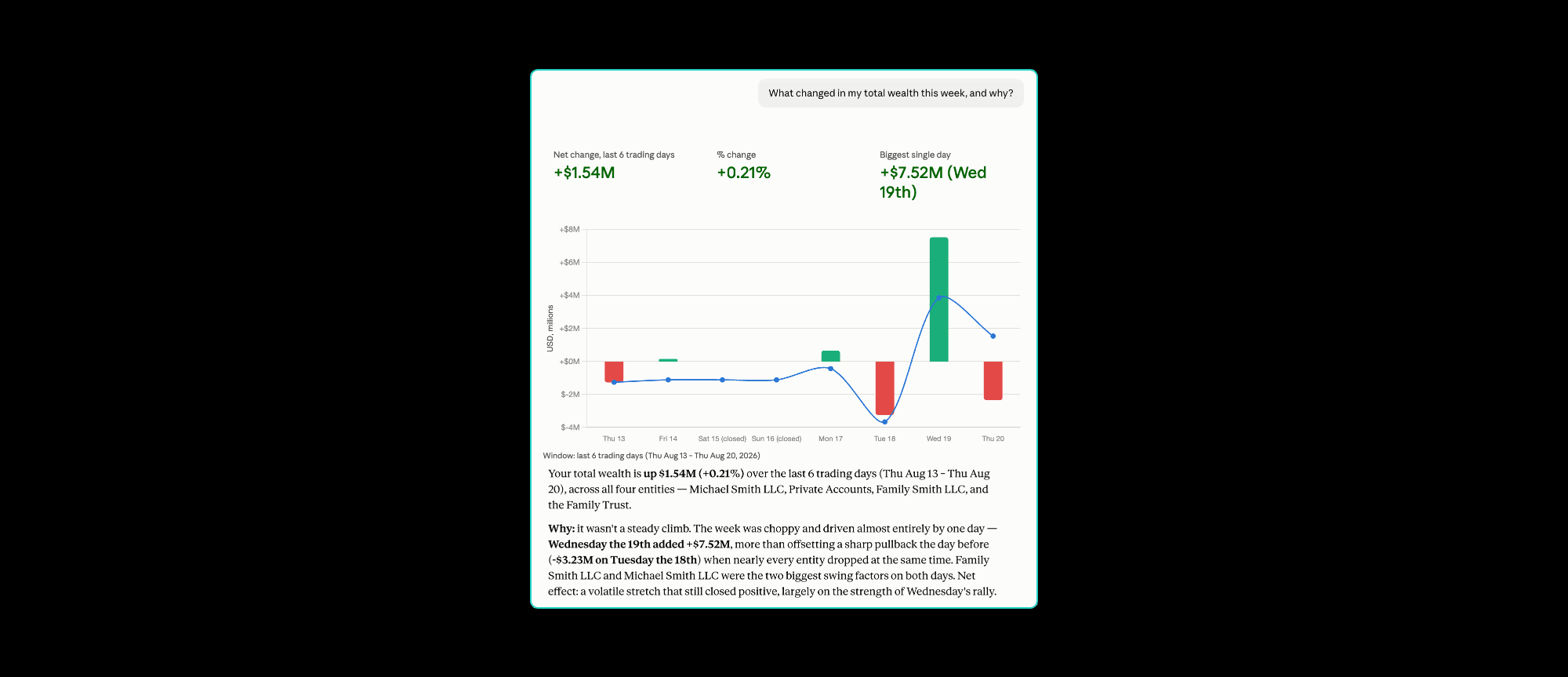
Real Prompts You Can Steal: How Family Offices Use AI Agents on Their Wealth Data
11 real prompts family offices run with AI agents on wealth data, from performance and liquidity to compliance and automation, with answers and screenshots.
Aug 25, 2026
AI,
Family offices